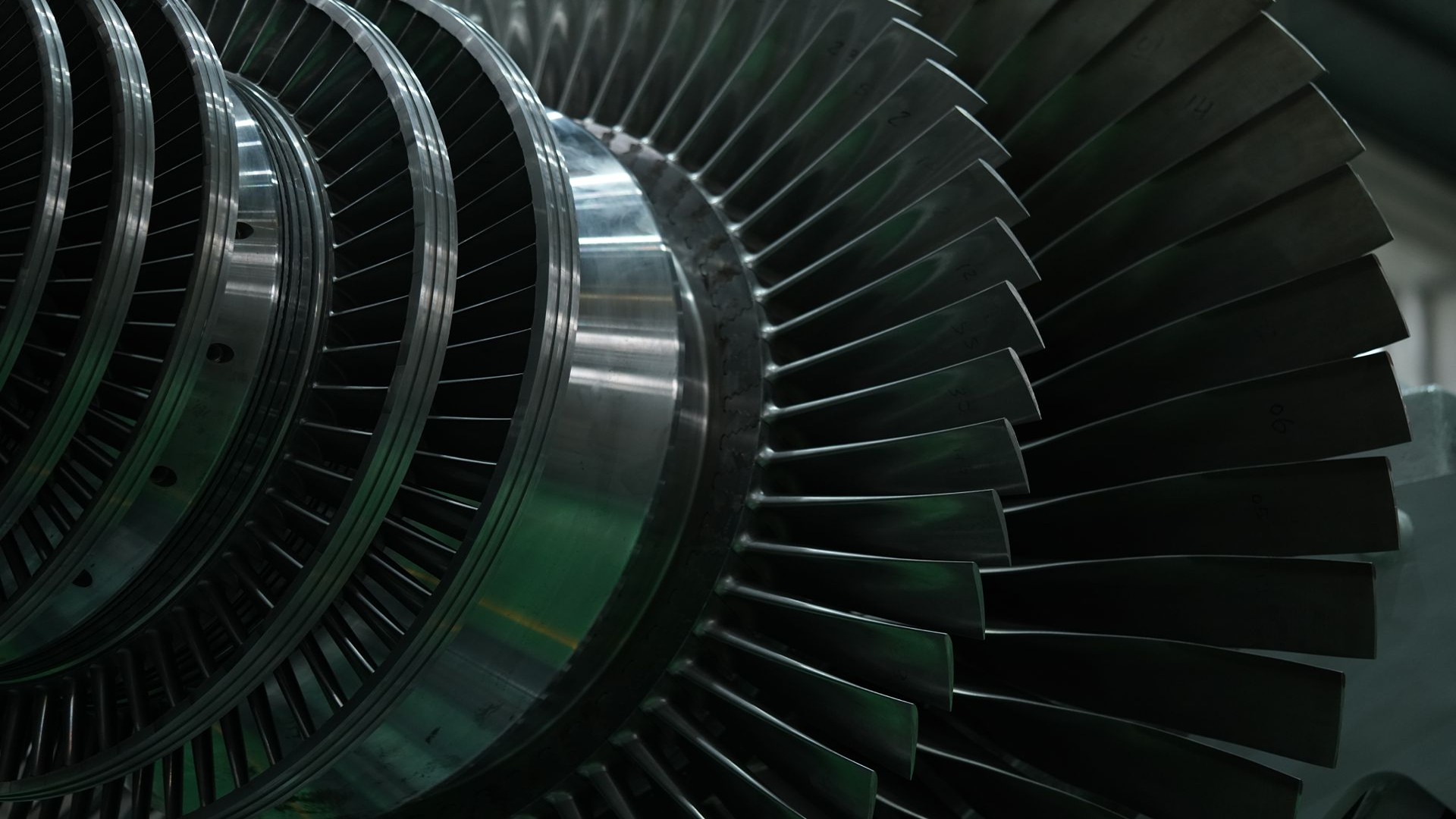

Steam Turbine Maintenance: A Complete Guide for US Plant Managers
Steam turbine maintenance is the difference between a machine that reliably runs for 30+ years and one that fails unexpectedly, taking an entire process unit offline with it. For plant managers across power generation, refining, chemicals, and manufacturing, this isn’t an abstract concern; a single unplanned turbine outage can cost a facility hundreds of thousands of dollars per day in lost production, not counting repair costs and potential safety exposure.
Yet steam turbine maintenance remains one of the more misunderstood areas of plant operations. Some facilities over-maintain, spending unnecessarily on inspections that don’t move the reliability needle. Others under-maintain, deferring work until a routine issue becomes a catastrophic failure. Getting the balance right requires understanding what actually needs attention, when, and why.
This guide walks through what steam turbine maintenance really involves, how predictive maintenance is changing the game, what a full overhaul looks like, and how to evaluate turbine maintenance companies and MRO partners if you’re building or refining your plant’s maintenance strategy.
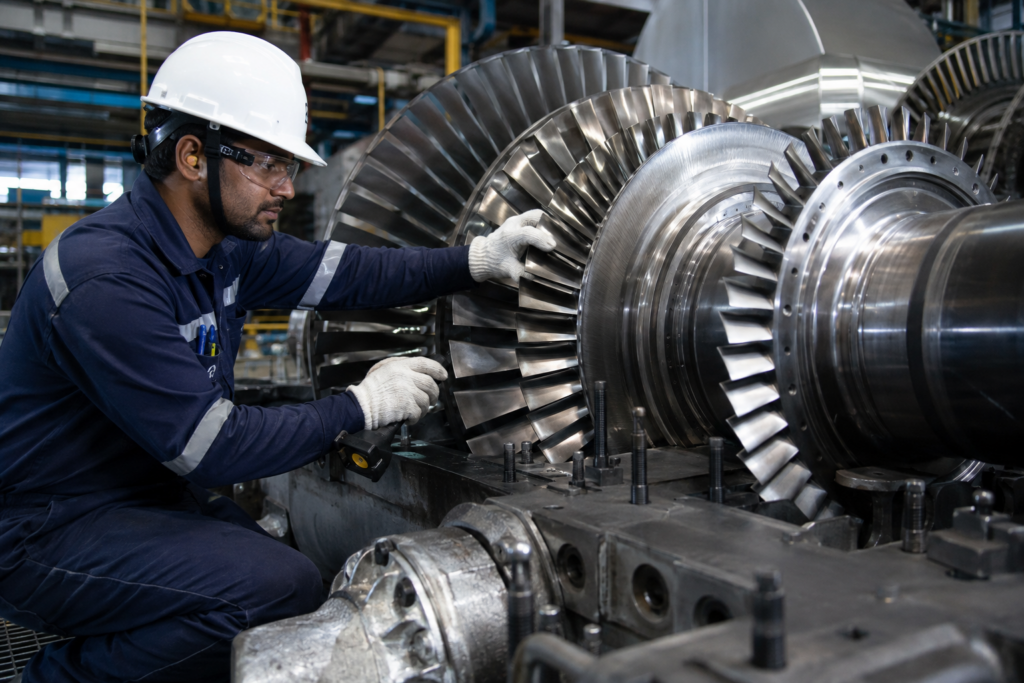
Alt text: Plant engineer in safety gear inspecting an industrial steam turbine, hands-on maintenance, factory floor setting
Why Steam Turbine Maintenance Matters More Than Most Plant Managers Realize
A steam turbine looks simple from the outside a rotor, blades, a casing, some piping. In practice, it’s one of the most mechanically stressed pieces of equipment in a plant. Rotors spin at thousands of RPM. Blades operate under constant thermal cycling, erosion from wet steam, and vibration loads. Bearings and seals work continuously to keep everything aligned and contained.
A few reasons maintenance discipline matters so much for this specific equipment:
- Long asset life, but only with care. A well-maintained steam turbine can run for 25-30+ years. A poorly maintained one can develop serious issues within a fraction of that time.
- High cost of unplanned downtime. Turbines often sit at the center of a plant’s power or process chain. When one goes down unexpectedly, everything downstream stops with it.
- Gradual degradation is easy to miss without the right monitoring. Blade erosion, bearing wear, and seal degradation often develop slowly, which means a facility without proper inspection and monitoring routines can be caught off guard by a failure that was actually building for months.
- Repair costs scale sharply with severity. A minor blade issue caught early might cost a fraction of what a catastrophic rotor failure costs to repair — plus the extended outage that comes with major unplanned work.
Alt Text: Disassembled industrial turbine rotor and casing during overhaul, workshop floor, precision engineering components exposed
For plant managers, the real question isn’t whether to invest in maintenance — it’s how to structure that investment intelligently across time, based on actual equipment condition rather than guesswork or rigid calendar schedules alone.
The Core Components of a Steam Turbine Maintenance Program
A solid maintenance program for steam turbines typically covers several distinct categories of work, each with different frequency and depth requirements.
1. Routine Inspection and Condition Monitoring
This is the ongoing, ideally continuous, work of tracking how the turbine is actually performing vibration levels, bearing temperatures, oil condition, steam parameters, and casing expansion, among other indicators. Routine inspections catch early warning signs before they become failures.
2. Lubrication System Maintenance
Turbine lube oil systems need regular oil analysis, filter changes, and cooler inspections. Oil contamination or degradation is one of the more common, and preventable causes of bearing and seal problems.
3. Minor Maintenance and Component Servicing
This includes tasks like seal adjustments, instrumentation calibration, valve servicing, and minor component replacements, the kind of work typically done during short planned outages without a full turbine teardown.
4. Major Overhauls
Periodically, often every several years, depending on service conditions a turbine requires a full overhaul: complete disassembly, inspection of all major components (rotor, blades, bearings, seals, casing), and replacement or repair of worn parts. This is the most involved and costly category of maintenance, but also the point where efficiency and reliability can be meaningfully restored.
5. Turbine Island Maintenance
For larger installations, maintenance often extends beyond the turbine itself to the broader “turbine island” auxiliary systems, control systems, and associated equipment that all need to function together for reliable operation. Comprehensive maintenance contracts increasingly cover this full scope rather than just the turbine in isolation.
Predictive Maintenance for Steam Turbines: The Shift From Reactive to Proactive
Predictive maintenance for steam turbines has moved from a niche practice to a standard expectation among plant managers who want to minimize both downtime and maintenance spend. The core idea is straightforward: instead of maintaining equipment on a fixed calendar schedule regardless of actual condition, use real-time data and condition monitoring to determine when maintenance is genuinely needed.
How Predictive Maintenance Works in Practice
- Vibration analysis tracks changes in rotor and bearing vibration signatures over time, flagging developing imbalance, misalignment, or bearing wear well before it causes a failure.
- Oil analysis identifies contamination, wear particles, or degradation in lubrication systems, often revealing developing mechanical issues indirectly.
- Thermal and performance monitoring tracks steam conditions, efficiency trends, and thermal expansion patterns to catch performance degradation that might indicate blade fouling, erosion, or seal leakage.
- Trend analysis and diagnostics software compiles this data over time, helping maintenance teams distinguish normal operating variation from genuine developing problems.
Why This Matters for Plant Managers
The financial case for predictive maintenance is fairly direct: catching a developing issue during a planned inspection window is dramatically cheaper than responding to an unplanned failure. It also allows plant managers to plan maintenance outages around production schedules rather than being forced into unplanned downtime at the worst possible time.
That said, predictive maintenance isn’t a replacement for periodic physical inspection and major overhauls — it’s a tool that helps determine when those interventions are actually needed, rather than relying purely on fixed time intervals that may not reflect real equipment condition.
Steam Turbine Overhaul: What It Actually Involves
A steam turbine overhaul is the most comprehensive maintenance event in a turbine’s operating life, and understanding what it involves helps plant managers plan budgets and outage windows realistically.
Typical Overhaul Scope
- Full disassembly of the turbine, including rotor removal and casing separation.
- Rotor inspection, checking for cracks, erosion, imbalance, and fatigue damage — often including non-destructive testing methods.
- Blade inspection and replacement, addressing erosion, corrosion, or damage accumulated over years of operation. This is also frequently the point where blade design upgrades are considered to improve efficiency.
- Bearing and seal replacement or reconditioning, since these components wear steadily over normal operation.
- Casing and steam path inspection, checking for erosion, deposits, or damage along the steam flow path that can reduce efficiency over time.
- Control and instrumentation system checks, ensuring governors, protection systems, and monitoring equipment are functioning correctly.
- Reassembly and testing, including alignment checks and, where possible, performance verification before returning to service.

Alt Text: Industrial control room with engineers reviewing performance dashboards and equipment data on multiple screens
Overhaul Frequency
Overhaul intervals vary significantly based on service conditions — a turbine running on clean, dry steam in a straightforward power generation application may go longer between overhauls than one operating in a harsher process environment with variable steam quality. Rather than relying purely on a fixed interval, many plant managers now combine standard interval guidance with condition monitoring data to determine the right timing for their specific equipment and operating history.
The Efficiency Upgrade Opportunity
A major overhaul isn’t just about restoring a turbine to its original condition — it’s often the best opportunity to improve on it. Re-engineering work during an overhaul, such as upgrading blade design or optimizing steam flow paths, can meaningfully increase efficiency and output beyond the turbine’s original specification, particularly for older units running well below current design standards.
Steam Turbine MRO: Building a Maintenance, Repair, and Overhaul Strategy
Steam turbine MRO (maintenance, repair, and overhaul) isn’t just a single event — it’s an ongoing strategy that plant managers need to plan for across the full life of the asset. A few principles worth building into that strategy:
- Match maintenance intensity to criticality. A turbine supporting a redundant, non-critical process doesn’t need the same monitoring intensity as one driving a single-train critical compressor with no backup.
- Combine calendar-based and condition-based approaches. Pure calendar scheduling can lead to unnecessary work or missed early warnings; pure condition-based monitoring without any baseline inspection schedule can miss slower-developing issues. The strongest programs blend both.
- Plan spare parts availability in advance. Long lead times on critical spares — rotors, specific bearing types, control components — can turn a planned outage into an extended one if parts aren’t sourced ahead of time.
- Budget for overhauls as a lifecycle cost, not a surprise expense. Overhauls are predictable, recurring events. Plant managers who budget for them proactively avoid the financial strain of treating them as unplanned emergencies.
- Document everything. Maintenance history, inspection results, and repair records build the dataset that makes predictive maintenance and long-term planning actually effective.
Choosing Turbine Maintenance Companies: What to Look For
Not every maintenance provider brings the same depth of expertise, and this decision matters more for turbines than for most other rotating equipment, given how specialized the engineering is. A few factors worth prioritizing when evaluating turbine maintenance companies:
1. Cross-Brand Expertise
Facilities don’t always run turbines from a single original manufacturer, especially older plants with equipment installed decades apart. A maintenance partner capable of servicing rotating equipment across brands — not just their own installed base — offers far more flexibility than one limited to proprietary equipment.
2. Re-Engineering and Efficiency Upgrade Capability
Beyond basic repair, look for providers who can meaningfully improve turbine performance during overhaul work — upgrading blade design, optimizing steam flow paths, and restoring or exceeding original efficiency levels rather than just replacing worn parts like-for-like.
3. Full-Scope Service Agreements
Long Term Service Agreements and Turbine Island Annual Maintenance Contracts that cover the turbine and its supporting systems comprehensively reduce coordination headaches compared to piecing together multiple vendors for different components.
4. Responsive Support Infrastructure
Given how costly unplanned downtime can be, 24×7 technical support and a global service network matter significantly — especially for plants where a delayed response to a developing issue is the difference between a planned repair and an unplanned outage.
5. Depth Across Applications and Capacity Ranges
A provider with experience across power generation, cogeneration, biomass, and waste heat recovery applications, and across a wide capacity range — brings broader diagnostic pattern recognition than one focused narrowly on a single turbine type or industry.
This is the space where aftermarket programs like Triveni REFURB operate covering repair, spares, overhauling, and efficiency improvements for rotating equipment up to 500 MW, across brands rather than only original equipment, alongside re-engineering services that upgrade blade design and steam flow paths to restore or enhance turbine performance. For plant managers managing aging or underperforming turbines, that combination of repair capability and performance upgrade expertise is often more valuable than a simple parts-replacement service.
For newer projects being planned from the ground up, the maintenance conversation often starts even earlier with the design of custom-engineered industrial steam turbines built around the specific fuel, steam conditions, and duty cycle a facility will actually run, which tends to reduce long-term maintenance burden compared to a poorly matched off-the-shelf unit.